

Eight regions, one strategy
Founded in the USA, steered from Germany, successful in eight regions around the world: how Big Dutchman built one group strategy and eight regional strategies on a single framework.
Jack and Dick de Witt. Those were the two poultry farmers who laid the foundation in rural Michigan, with an automatic feeding system for chickens. What began with the “Big Dutchman” system around the time of the Second World War grew over the decades into an international growth story that has never been interrupted. From Vechta-Calveslage in northwestern Germany, the global market leader in agricultural technology is active in more than 170 countries, organized into eight regions: the USA, Latin America, Sub-Saharan Africa, North Africa/MENA/India, Asia, China, Russia and Europe. Equipment and systems for poultry and pig farming, barn management, climate control and animal nutrition: that is Big Dutchman's core. On top of that, the family business, long since a global group, is active in greenhouse technology and insect farming.
A hidden champion, in other words, operating right in the middle of the big tensions of our time: between rural life and high tech, animal welfare and global food security, industrial production at massive scale and tailor-made solutions for traditional farming.
A framework that makes room for real debate
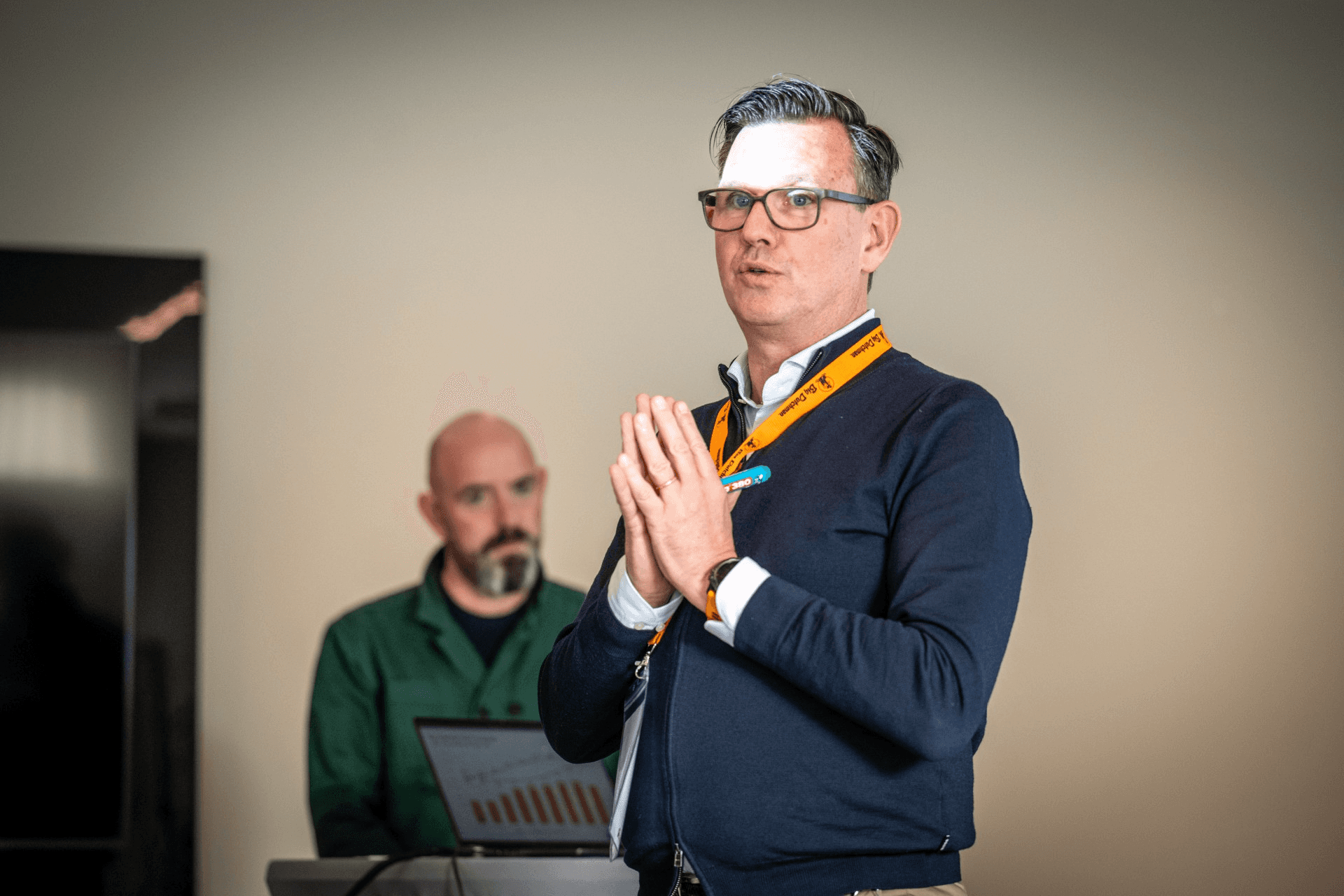
How do you build one overarching strategy that gives everyone direction when the demands look this contradictory, and still let the regions shape their own paths for their own markets? Steffen Bersch, CEO of Big Dutchman since spring 2025, chose the StrategyFrame® as the framework for this process. “We wanted to approach it systematically and, at the same time, use the potential that artificial intelligence has for strategy work,” says Dr. Lina Sofie von Fricken, Head of ESG & Strategy.
In September 2025, Big Dutchman started the analysis phase at group level with a consolidating strategy workshop, bringing in representatives from every region and every central function. Working along the StrategyFrame®, the management team discussed the starting position and developed a shared target picture for the entire company worldwide. In a second round, the results were cascaded down to capture local perspectives in each analysis area, each market's contribution to the target picture, and concrete measures.
The AI-driven consolidation that followed painted a clear picture quickly: instead of settling for a one-size-fits-all answer, Big Dutchman now clearly differentiates between innovation-driven markets and volume markets. “The fact that the StrategyFrame® imposes a kind of corset helped us enormously to focus on what matters,” says von Fricken. “Interestingly, it was a technical solution that first created the space in which we could really engage with the substance.”
Co-creation as a value in itself
In a parallel track, Big Dutchman's many portfolio companies went through the StrategyFrame® process alongside the group and its regions. The advantage: because everyone worked through one process and one framework, alignment with each other and with the overall direction became much simpler. The development work is now complete, and Big Dutchman's management has the foundation to drive its growth course systematically.
Would the result have been similar if outside consultants had developed the strategy on their own? For von Fricken, that is the wrong question. “The co-creation process had a value in itself, because it let us put the knowledge of the entire company to use. It definitely strengthened our culture and created more commitment than an externally developed strategy ever could.” Especially since the analysis now puts on a solid footing what was clear in outline from the start: to stay on top while Chinese suppliers attack in the volume markets and innovative competitors catch up in heavily regulated Europe, each market needs its own recipe.
Market Intelligence shows where sales can grow
So that hard, current data rather than individual gut feeling forms the basis, Big Dutchman also relies on StrategyFrame® Market Intelligence beyond the strategy process. It gives real-time access to key information on the 50 most important competitors, the largest pig and poultry producers, the volumes of individual markets and the trends that dominate them. A news feed adds the latest developments relevant to agricultural technology.
Martin Prang, Head of Global Sales Excellence and the driving force behind the Market Intelligence rollout, sees the biggest potential in sales. “Until now, the market data we used was structured differently and heavily fragmented by region. Whether we could react immediately when, say, a competitor somewhere in the world opened a new sales office was often a matter of luck.” In future, a sales manager can approach a customer sooner after learning about their new project from a news flash.
White-spot analyses and automated newsletters
Market Intelligence makes white-spot analyses of untapped markets straightforward. It also keeps a report library that is always up to date and sends automated newsletters that bundle information by country or topic. The plan is to have key users in every region who answer colleagues' questions about working with the tool. Around 1,000 salespeople worldwide will get the chance to put the full power of artificial intelligence to work for the business. “With Market Intelligence, we can spot market and customer developments around the world early and turn them into concrete opportunities for our business,” says Prang. “That's how we help our sales teams approach customers in a targeted way and develop the right solutions for the growing demand for protein.”
Pig farming, poultry farming and egg production, adapted to the conditions in each market, are becoming more and more important. The more precisely Big Dutchman can identify the need for products and systems in its regions, the better its chances of staying on top in these markets, whether a market is growing or restructuring, for example toward higher animal welfare standards.
Back where it started: Holland, Michigan
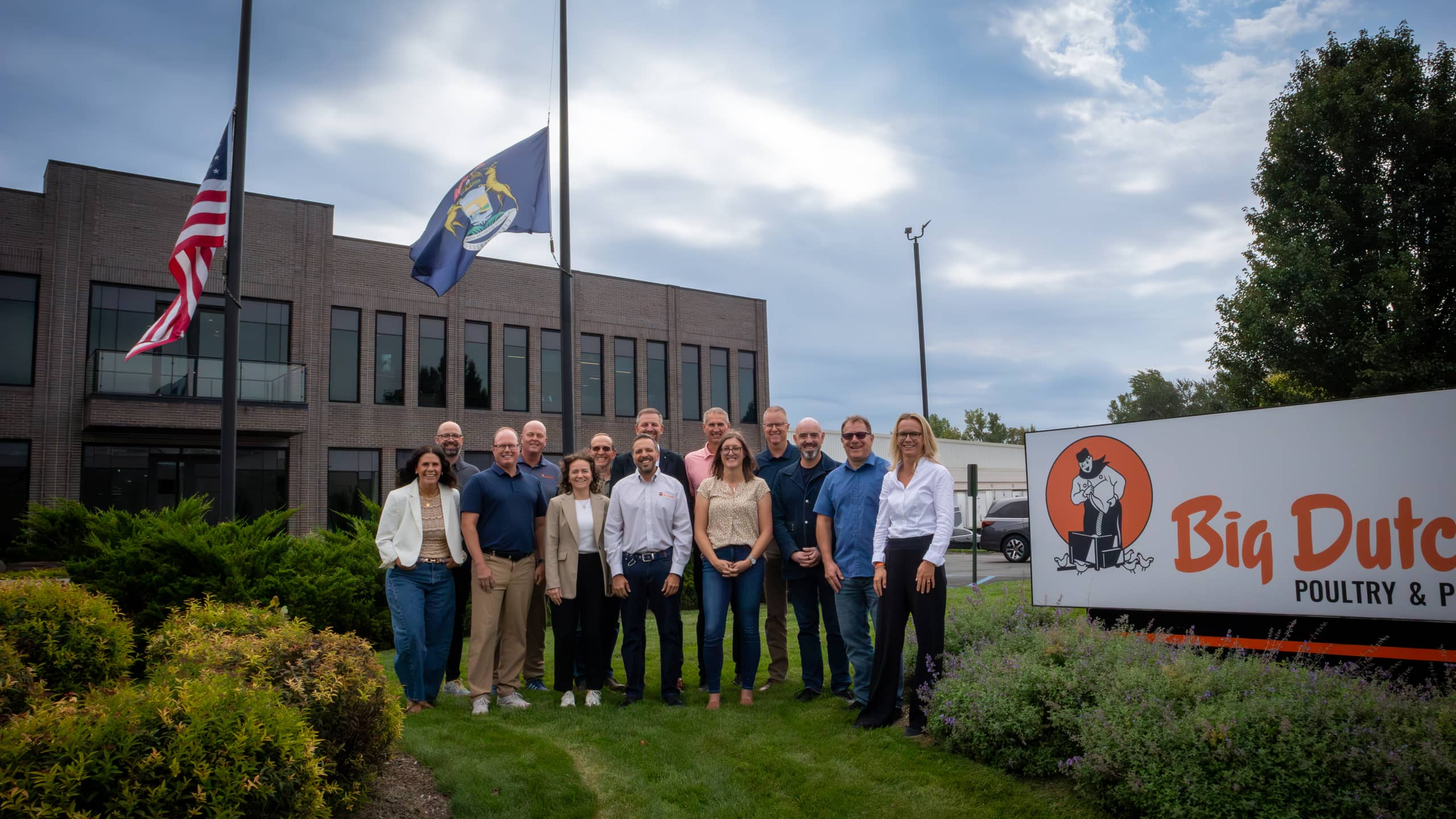
On August 26, 2026, Big Dutchman North America rolled out its regional strategy to its people, face to face, in Holland, Michigan, the town where the company was founded in 1938. Not a board deck and not a PDF that dies in an inbox, but a strategy built by the North American team itself and aligned with the global group strategy developed in Germany.
Sylvester (Budd) Bentley, Head of Region North America, called it the most complete external look at a business he has ever been through. On working with AI, he says: “It's easier to edit than it is to create. You spend less time on the perfect presentation and more time on the actual content.”
Acting from a position of strength
How does the strategy become concrete at group level and in the regions? Von Fricken relies above all on conversations to bring its meaning for day-to-day work home to the team worldwide. Big Dutchman has launched a dedicated program for this under the name BigStep 2030, with a Project Management Office in Calveslage holding the threads together. “The good thing is that we act as a company from a position of strength, with a leading position in a booming sector,” she says. “This isn't about cutbacks, and that naturally makes people more open to change.”
Big Dutchman stays true to its roots. The USA, the country where Jack and Dick de Witt founded the company, will remain a key market: for premium solutions that are in high demand in California as much as for farms in every other state.
Big Dutchman: a family business with an innovative mindset
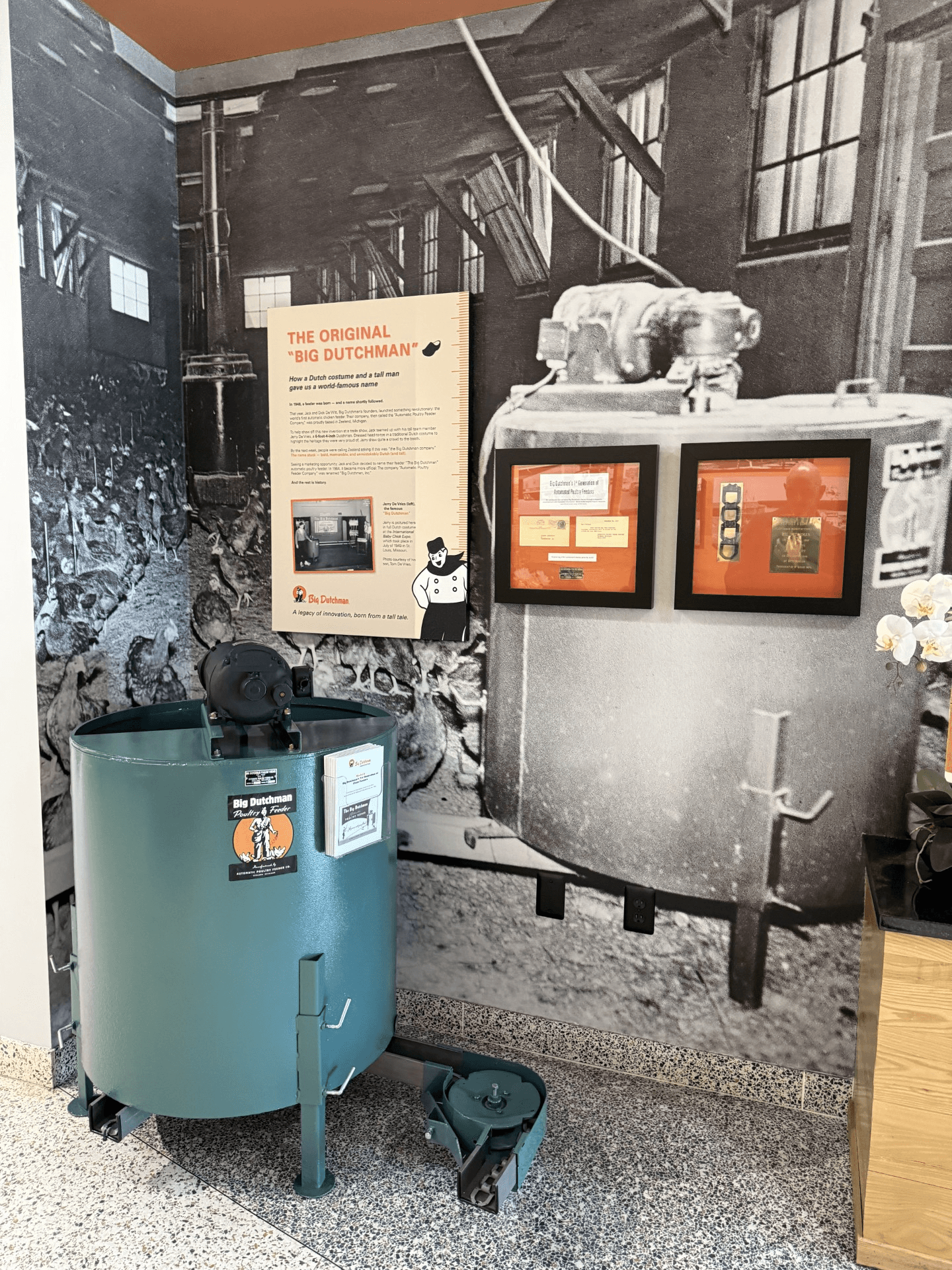
Companies moving their headquarters from Europe to the USA is nothing unusual. At Big Dutchman, it went the other way. After the founding in 1938, Jack and Dick de Witt built the business internationally from Michigan. Josef Mehrpohl, a poultry farmer in Vechta-Calveslage, came on board in the late 1950s as a sales agent for the German market and later ran the company as its managing director. Since his management buyout in 1985, Big Dutchman has been a family business again. His son Bernd Mehrpohl led the company as CEO for 31 years and has chaired the supervisory board since 2023.
Today the Big Dutchman family comprises 200 agencies in 80 countries, 8 regional headquarters, more than two dozen subsidiaries and around 3,500 employees. In 2025, group revenue passed 1.5 billion euros for the first time. Over the decades, Big Dutchman has shaped agriculture again and again with innovative solutions. With the BigFarmNet management system, the company was a pioneer in the market in 2010. Today, its cloud solution BFN Fusion is driving the digitalization of the industry.