 The StrategyFrame® Method
The StrategyFrame®:Your whole strategy on one page.
One picture that answers the three questions every strategy has to answer: what do we need to know, what do we need to decide, and what do we need to do?
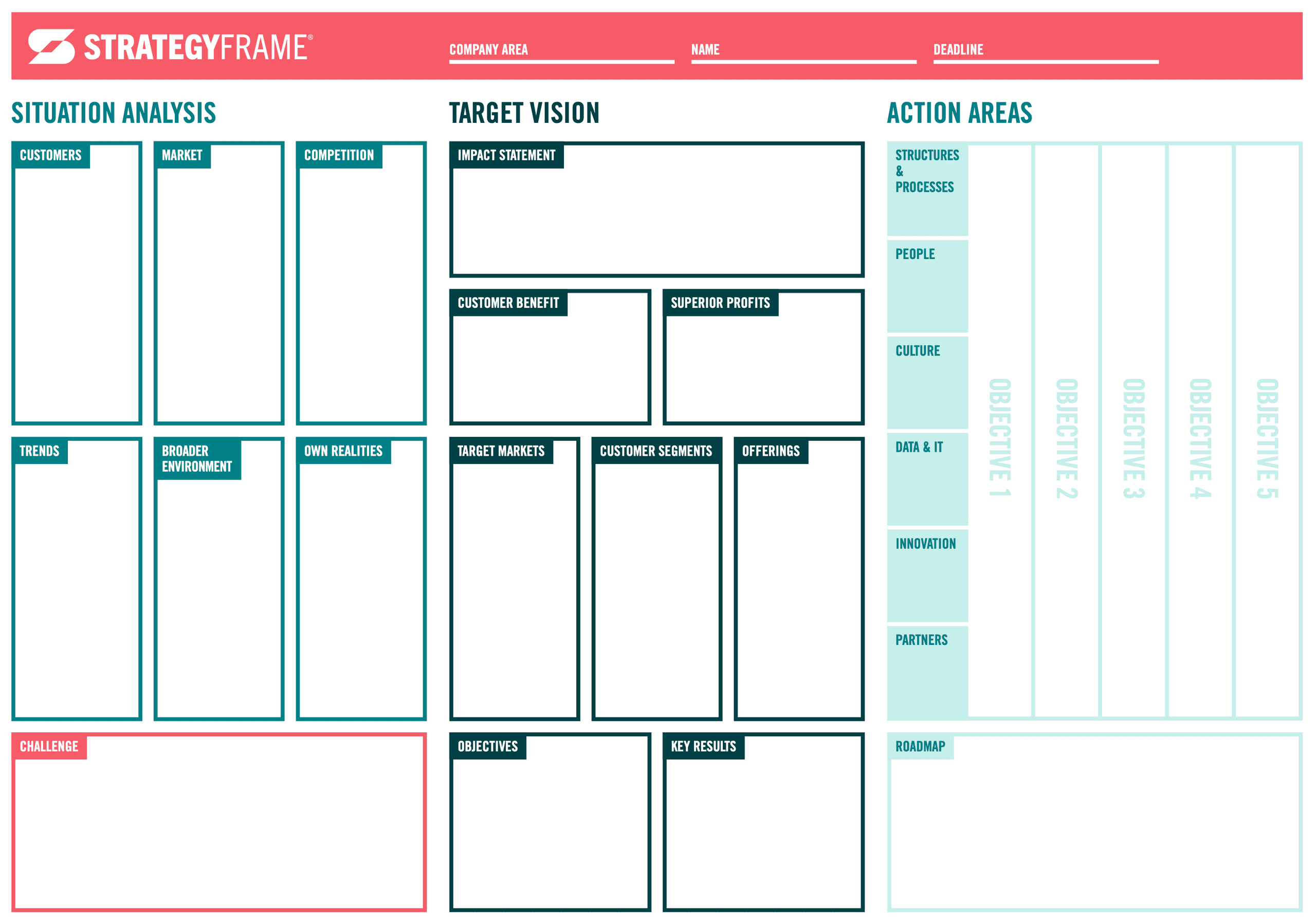
Three core modules.
Three questions.
The StrategyFrame® connects and visualizes the essential elements of strategy work in one overall picture — one that gives everyone involved orientation and clarity: on the content, on the process, and often emotionally too.
1 · Situation analysis
Where do we stand today, and what are our biggest challenges?
You analyze where your company stands in its current fields of action, identify possible new ones, and make sense of the external environment.
Six fields carry the answers. Market: where your biggest potential sits, and which markets you actually address. Customers: what they need, and how that is shifting. Competition: who you are really up against. Trends: what is reshaping your industry. General environment: what is happening around you. And your own realities: what is actually true inside the company.
Out of those six comes the one thing the rest of the frame is built on — your challenge.
2 · Target picture
Where do we want to go, and which concrete goals are we pursuing?
The second module sets your focus on four levels.
Impact: your impact statement defines how the company intends to create lasting value for the economy, the environment and society. Customer value and superior gains: what you do better or differently from the competition, and how that turns into gains the competition cannot match.
Playing field: the heart of focusing. Which target markets, which customer segments, which offerings — and which competitors you are willing to step into the ring with. Priorities: goals and key results define what comes in which order, quantitative or qualitative.
3 · Fields of action
Where do we have to act and change things in our organization?
Six levers of your business system: structures and processes, people, culture, data and IT, innovation, partners.
For every goal your team describes the current state of the organization and the state it needs to reach. The gap between them is where the obstacles become visible. Each one turns into initiatives, projects and measures, sorted into those six fields.
What you end up with is a roadmap, not a wish list.
The workflow: eight steps from first plan to daily operation
The frame is the picture. The workflow is how a leadership team fills it and keeps it running. Four steps develop the strategy. Launch and Implement are set up once; Execute and Adjust then run as a continuous loop.
Developing the strategy
Who gets involved, which analyses matter in your situation, how much time each phase gets. The AI suggests which modules pay off in your context and which you can skip. You get a roadmap in hours instead of weeks.
This is where AI does the most. Specialized agents track market, competition and macro trends, and a synthesis layer brings their findings together and surfaces the contradictions. Nobody assembles market reports by hand anymore.
The most demanding step, because decisions with long-term impact get made here. In the workshop an AI assistant works with the leadership team in real time, sharpens impact statement and value proposition, and makes hidden assumptions visible.
Decisions become fields of action and initiatives. The AI checks whether goals and initiatives fit and finds the gaps: fields without initiatives, initiatives without a goal. Are we doing what we decided, and leaving out what we didn't?
Running the execution
The visible starting shot. The strategy reaches the organization in plain language, and the foundation goes in at the same time: platform, top-level OKRs, steering circles, reporting routines. What matters is that no silence follows the announcement.
OKRs cascade through every level, fields of action become projects and measures. An OKR assistant checks that team, unit and company goals fit and plays through shifts in priority before they get expensive. Every report ends with a decision: prioritize, sharpen, reallocate or stop.
OKRs and the project portfolio come together on one board: each objective with its key results, current value, target and the projects behind it. Monthly reviews, quarterly sharpening. You state the intent in chat, and the system carries the change down the cascade.
The market doesn't stand still. Monthly review, quarterly update, annual retreat. In the background, data agents scan market, competition and regulation against your target picture and flag when an assumption stops holding.
StrategyFrame®AISee it for yourself.
Start with the demo. You get a sandbox account with a StrategyFrame® already filled in, so you can see what all of this looks like once a real company has worked through it.
Rather talk it through first? Book a 30-minute call. No pitch and no slide deck, just a straight conversation about where your strategy stands.
Get a demo